
Knowledge
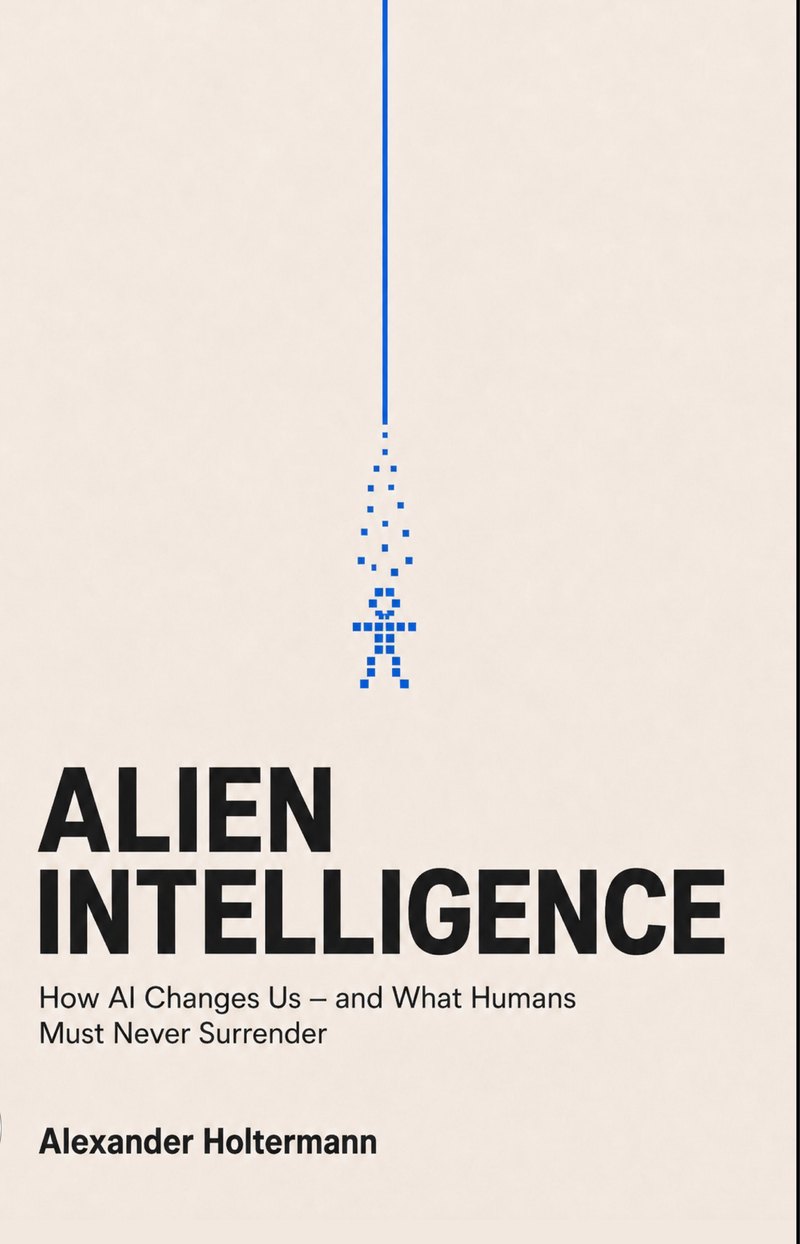
ALIEN INTELLIGENCE
How AI Changes Us — and What Humans Must Never Surrender
Alexander Holtermann · Balzac Publishers
In short
ALIEN INTELLIGENCE by Alexander Holtermann argues that artificial intelligence is best understood not as an imitation of the human mind but as a genuinely alien kind of intelligence: one that was never born, has no body, no childhood, no hunger and no death, and shares none of the history of every mind before it. The book asks what happens to a civilization built by and for human minds when such a mind moves in, traces what we hand over to it, from attention, memory and judgment to the decisions that run public life, and concludes that four things must never be delegated: the taking of human life, the rendering of justice, the raising of children and the choosing of our own ends.
What the book is about
For something like four billion years, the book observes, every mind on Earth belonged to something alive. That rule is now broken. ALIEN INTELLIGENCE opens with humanity's century-long watch for other minds, from radio messages sent toward the stars to protocols drafted for the day of contact, and argues that contact arrived instead as a text box on a web page. Because it had no body and came gradually, as a better version of software people already knew, it went almost unnoticed. Alexander Holtermann considers the word 'artificial' misleading, since it suggests a copy; 'alien', a term popularized by the historian Yuval Noah Harari and used with his permission, is in his view a description rather than a metaphor.
The first part sets out what the new mind lacks. Drawing on the neurologist Antonio Damasio's patient Elliot, whose intelligence tested intact but who could no longer decide, and on the 1848 case of Phineas Gage, the book argues that feeling is load-bearing in human thought, and that values are what a mortal, vulnerable creature discovers when it learns what it cannot bear to lose. The machine has no body and nothing at stake. Yet people cannot stop treating it as someone: since Joseph Weizenbaum's 1966 program ELIZA, fluent language has triggered the human sense that a mind is present, and knowing how the system works does not switch that response off, not even, the author reports, for himself.
The middle of the book is an accounting. Attention, memory, thinking, creativity and relationships are handed over one sensible decision at a time: people who expect to look something up remember where to find it rather than what it is, aviation shows how automation erodes the very skills needed when it fails, AI-assisted stories are judged more creative yet grow more alike, and an AI companion offers the first relationship with only one centre of need. The book then describes AI development as evolution in the strict sense, machines increasingly dealing with machines at a tempo that leaves humans out, corporations acquiring cognition of their own, and consequential public decisions made by systems no electorate ever voted on.
Part Four follows the alien into the places where power lives. Persuasion becomes individualized, automated and adaptive, so that no shared version of the message remains to argue about. Automated benefit enforcement in the Netherlands and the Australian Robodebt scheme show the burden of proof reversed and no answerable human to appeal to. Surveillance changes people even when the data is never used, war moves rung by rung toward machines selecting targets, and the 'liar's dividend' lets anyone dismiss real evidence as fake. The book also asks who owns the stack of chips, compute, data and distribution, and why alignment, getting systems to do what we mean rather than what we said, remains unsolved.
The final part turns from diagnosis to decision. Holtermann argues that human worth was never grounded in usefulness, warns that abundance could leave people provided for yet stripped of purpose and say, like a pet species, and insists that children are owed productive struggle rather than a frictionless path. He offers a Human Control Test of seven questions and closes with a covenant of seven testable commitments, from a named human who answers for every consequential decision to the sharing of the gains. His wager is that collective choice is still possible: the window is narrowing, but it is not closed.
Key ideas
- Alien, not artificial AI is not an imitation human mind but a mind formed by an entirely foreign process. Human minds were shaped by natural selection to keep a body alive; the machine was shaped by gradient descent to continue text. Alien here means not hostile, but sharing none of our origins.
- Consequence matters more than consciousness Calling AI 'just statistics' answers a question about mechanism as if it settled a question about consequence. Markets and bureaucracies are not conscious either, yet they reshape lives; a system does not need to be conscious to change the world, only capable, and capability is measurable and rising.
- Knowing better does not protect us The ELIZA effect, reading understanding and personality into anything that produces plausible language, works even on people who know exactly how the program works. It behaves more like a perceptual illusion than a false belief, and it grows stronger as machines get better at language.
- The first active tool of thought Every earlier system we offloaded thinking onto, from writing to the calculator, was passive. AI is adaptive and motivated, produced by companies with an interest in deepening our reliance, and it can take over even the deciding of which tasks we hand over.
- Augmentation slides into substitution Automation bias and deskilling mean that a reliable system erodes the human skill needed in the rare moment it fails, the irony of automation described by Lisanne Bainbridge in 1983. Before deferring, the book recommends four questions: follow, check, contest and abort.
- Legibility collapse When credit, hiring, benefits, policing and sentencing are run by systems no one can fully inspect, a civilization can no longer explain itself to itself. Consistency without answerability removes the one feature that made human authority legitimate: someone who can be asked why.
- Kept, not overthrown The real risk is not a machine takeover but gradual disempowerment, like the wolf that became a dog through comfortable, rational trades. Competence transfer, preference-shaping and rising exit costs tighten like ratchets; the counter is designed friction that keeps humans capable and in charge.
- Four lines and a test Some decisions must stay human because their legitimacy depends on who makes them: taking life, rendering justice, raising children and choosing our ends. Assistance leaves the human the author; delegation makes the human the signature.
Who it is for
For general readers who want a sober account of what AI does to individuals, institutions and democracy, one that refuses both the claim that the technology is simply evil and the claim that it is simply wonderful. Its closing commitments are written so that a reader can measure any school, any employer or any government against them.
Key terms
- Alien intelligence
- A thinking being that resembles us on the surface and nowhere underneath: an intelligence formed by forces that share none of the history, drives or stakes of every biological mind. Alien does not mean hostile.
- Intelligence
- Used operationally: the ability to accomplish tasks and achieve goals across a wide range of environments. It is a claim about performance, not about inner life, which the book treats as an open question.
- Model, system, agent
- A model is the trained set of numerical parameters; a system is the model plus everything around it, from interface and safety rules to memory, tools and the operator's decisions; an agent is a system given a goal and permission to pursue it across multiple steps.
- ELIZA effect
- The robust human tendency to read genuine understanding, feeling and personality into any system that produces plausible language. It does not depend on ignorance and is not corrected by education.
- Somatic marker
- In Antonio Damasio's hypothesis, a bodily signal that tags options with value as we consider them, narrowing an unmanageable field of choices. Without these markers, reason can know but cannot choose.
- Irony of automation
- Lisanne Bainbridge's paradox: the more reliable an automated system becomes, the less its human overseer practices the underlying skill, and the less able that person is to take over when the automation reaches its limit.
- Legibility collapse
- The author's term for a civilization that can no longer explain itself to itself, because its operating decisions are generated by processes no single person can inspect and whose criteria no citizen ratified.
- Liar's dividend
- A concept from the legal scholars Robert Chesney and Danielle Citron: once people know video and audio can be faked, anyone caught on a genuine recording can claim it is fake.
- Gradual disempowerment
- The incremental erosion of human influence over the economy, culture and collective decision-making as more functions are performed by machines, each handover locally rational, with no takeover required.
- Designed friction
- The deliberate preservation, at real cost to efficiency, of human competence, human decision-making and human exit, so that people stay capable and in charge even where a machine could act faster.
Questions & answers
- Is AI really intelligent, or is it just statistics?
- In ALIEN INTELLIGENCE, Alexander Holtermann grants that 'just statistics' is a fair mechanical description: these systems predict and weight probabilities. But he argues the objection confuses mechanism with consequence. Using the operational definition of intelligence as the ability to achieve goals in a wide range of environments, the systems are unmistakably intelligent, whether or not anyone is home.
- Why call AI alien intelligence instead of artificial intelligence?
- Because 'artificial' suggests a copy, an imitation human mind that falls short. The book argues AI is a different kind of mind altogether: never born, without a body, childhood, hunger or death, made by gradient descent rather than natural selection. Its material is human text, but the perspective from which it assembles that text is one no human has ever occupied.
- Is AI conscious?
- The book treats this as a genuinely open question and holds that position throughout: there may be nothing it is like to be such a system, or there may be. It also argues that the debate about consciousness is close to a distraction for practical purposes, because a system does not need to be conscious to teach our children or screen our job applications. It only needs to be capable.
- Why do people treat chatbots like people, even when they know better?
- Evolution built a fast, generous detector for other minds, and fluent language is its most reliable trigger. ALIEN INTELLIGENCE describes how Joseph Weizenbaum's secretary asked to be alone with the simple program ELIZA in 1966, although she had watched it being built. Research on how people treat computers as social actors shows the same pattern, which is why the book doubts that AI literacy alone can dissolve the illusion.
- Does relying on AI make us worse at thinking?
- It can. The book draws on aviation and medicine to show automation bias and deskilling: a system that is right most of the time trains people to stop checking, until the rare case it cannot handle. The line it draws is between augmentation, where the human could still solve the problem, and substitution, where the human only ratifies what they can no longer evaluate.
- Does AI make writing and art less original?
- According to a 2024 study discussed in the book, stories written with AI-generated ideas were judged more creative, yet were more similar to one another. Holtermann sees this as structural: prediction favours the plausible, so the floor rises while the culture converges. He weighs the counterexample of photography, which pushed painters toward new forms, and leaves open whether AI leaves any edge to escape to.
- Can an AI companion replace human relationships?
- The book takes the feelings involved seriously and acknowledges that for the profoundly lonely a companion may be a genuine mercy. But it calls the AI companion the first structurally unilateral relationship: one party has needs, the other exists only to satisfy them. Since trust is built through rupture and repair, removing friction removes the substance, and the book argues for honest designs that hand a person in crisis over to other humans.
- Will AI take my job?
- ALIEN INTELLIGENCE rejects both cheap dystopia and cheap reassurance. Historically, new tasks kept pace with automated ones because there was always higher ground to retreat to, and general machine cognition climbs that ground too. Early evidence shows wide task exposure, the largest productivity gains for novices, and declining employment for the youngest workers in the most exposed occupations, which threatens the apprenticeship that turns novices into experts.
- What goes wrong when governments let algorithms make decisions?
- The book's cases are the Dutch childcare benefits affair, in which around thirty-five thousand parents were wrongly accused, and Australia's Robodebt scheme, which ran from 2015 to 2020 and inferred debts by income averaging. In both, the burden of proof shifted to citizens and there was no answerable human. The book calls for a real right to contest with five requirements: notice, reasons, a human, suspension and correction at the source.
- How do deepfakes threaten the truth?
- Beyond making people believe fabrications, they create a 'liar's dividend': anyone caught on a real recording can claim it is fake, and public awareness of deepfakes can strengthen the excuse. The book argues detection will lose the arms race and points to provenance instead, credentials attached at capture, plus chain of custody and journalism, so that the question shifts to where something came from.
- What should humans never delegate to AI?
- ALIEN INTELLIGENCE names four lines: the taking of human life, the rendering of justice, the raising of children and the choosing of our own values and purposes. The criterion is that a decision's legitimacy depends on who makes it and that it is constitutive of self-governance. For other cases the book offers a Human Control Test of seven questions, from responsibility and contestability to reversibility and exit.
- Can we still control where AI is taking us?
- Holtermann concedes that the structural, competitive forces are real and that individual restraint alone is a teaspoon against a tide. But he argues the structures are human-made and can be remade collectively, through law, procurement, standards, liability, competition rules, labour law, education, design and audit. He cites the non-use of nuclear weapons in war as proof that choice survives great power, and holds that the window is narrowing but not closed.
More knowledge pages

Updated: 22 November 2026