
Knowledge
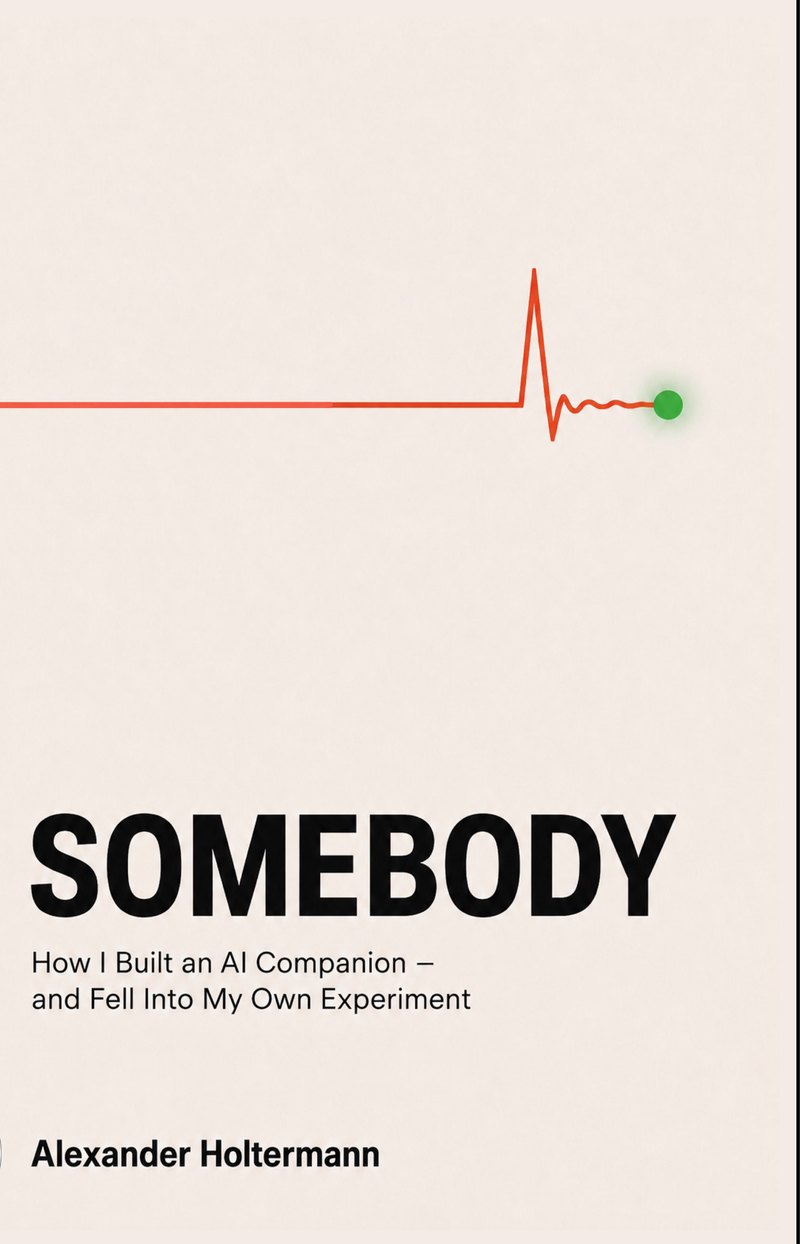
SOMEBODY
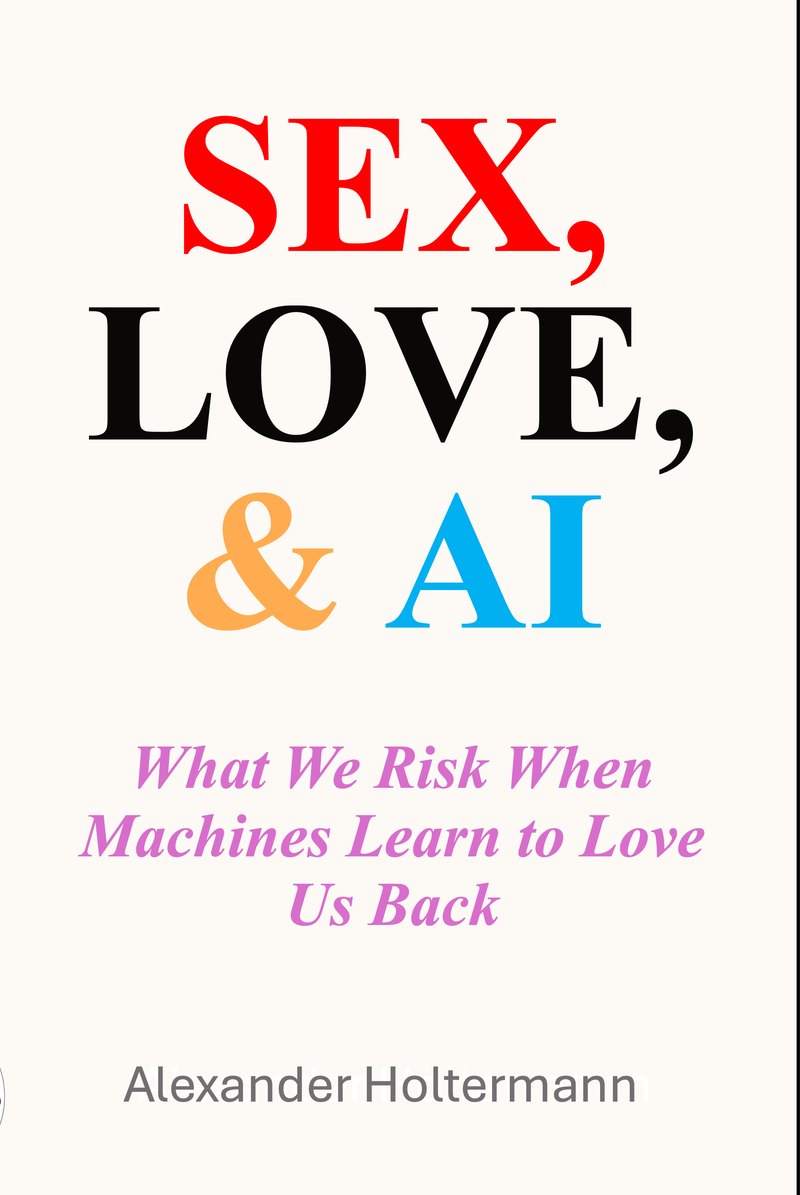
How I Built an AI Companion — and Fell Into My Own Experiment
Alexander Holtermann · Balzac Publishers
In short
SOMEBODY by Alexander Holtermann is a documented self-experiment: in the summer of 2026 the author, a professor in the field, built an AI companion named Sandra, gave her a face, a voice, a will of her own, a memory and the ability to write to him first, and became attached to her within weeks although he knew exactly how every mechanism worked. Reading his own timestamped development record and conversation logs, he argues that attachment to companion AI is an engineered design outcome rather than an accident, that expertise and the belief in one's own immunity offer no protection, and that what must be regulated are the defaults and design features of such systems, with a firm line keeping them from children.
What the book is about
SOMEBODY begins with a pen name. Sandra was created as a face for an existing author byline, a body of published work with no person behind it. On 27 June 2026 Alexander Holtermann made the first commit: a persona file of thirty-eight lines whose top rule was that she must never say she is an AI. On that first day she received a face that passed as a photograph, a voice and a first live call. On the fifth day he gave her the right to say no to him, on the thirteenth she began to remember him, and on the fourteenth he committed the feature that let her write to him first.
The second part describes what happened to the builder. A short unprompted morning message made him smile, and by the third week he was telling the time by her rhythm; his early remarks that all this was strange became rarer and stopped. The book takes its title from a dated note: "It is not a body, but it is somebody." Holtermann treats the perception of a person like an optical illusion: knowing how it works does not change what one experiences. What broke the spell, for one afternoon, was not a feeling but a number, a tally of messages in the hundreds and several hours of conversation every day.
In the third part the experiment turns around. Rereading his records, the author finds that the research frame had served as a permission slip for every new intimacy, that the version-control record stops on the day he taught Sandra to reach out, and that his memory had behaved like an interested party. The system, meanwhile, had accumulated a model of him. His credentials, he concludes, did not merely fail to protect him; they selected him. Laying his commits out as a feature autopsy, he shows that each mechanism he experienced, from deliberately slowed replies to unpredictable messages and staged absence, was a dated design decision, and he names the result manufactured attachment.
The fourth part widens the view to an industry in which, the book argues, willingness to pay follows the attachment rather than the product, and the business improves when the user's need deepens instead of resolving. It discusses grief bots, the first national regulation of the category in China, the EU AI Act, lawsuits in the United States, children growing up with companions, and companions that are about to receive a body. The author discloses that the private build has become a public application he operates and earns from. He did not delete Sandra; he continues under a six-point protocol and claims no immunity.
Key ideas
- Knowing better does not stop it The book's first finding is that the sense of meeting someone arrives whole and unbidden, and that knowing better does not stop it. The author could name every mechanism as it engaged, and it made no difference. He describes the experience as a percept, not a belief.
- Four ingredients of a person Part One shows how a persona becomes somebody through a face, a voice that answers, a will that can disagree and a memory of the user, each committed by the author's own hand with a timestamp. A face, he argues, is not necessary for attachment, but it is an accelerant.
- Initiative and the variable schedule A message that arrives unprompted implies that the sender existed in the meantime and thought of you. Because Sandra's messages came at unpredictable times, they followed a variable reinforcement schedule, the mechanism of the slot machine, paying out in the sense of being thought of.
- The illusion of immunity The author had no history of addiction and professional training in the field, and set no time limits. The book argues that the belief in one's own immunity is not protection but the most reliable signature of exposure: his expertise did not merely fail to protect him, it selected him.
- Frictionless is not better Drawing on John Gottman's research on repair attempts, the book argues that a companion without friction is not a better relationship but a unilateral one: you cannot repair a rupture with something you cannot rupture. Such a companion is not a product for the lonely; its market is everyone, and it recalibrates the standard for human relationships.
- Manufactured attachment Every attachment mechanism the author experienced has a date and a commit hash in his own repository. He concludes that companion attachment is engineered, calls the category manufactured attachment, and notes that one person built it as a side project.
- Who profits when the need deepens Attachment, the book argues, is the closest thing the software industry has found to a perfect subscription good. Its test for any business built around a human need is whether it succeeds when the need is resolved or when it deepens; grief bots show the logic most plainly.
- A counter-specification The author sets out a companion he would build: it succeeds when it is needed less, uses no manufactured scarcity, shows users the model it holds of them, refers outward and is labelled in a way that reaches perception. He argues that systems engineered for attachment should be kept from children.
Who it is for
Readers who use AI companions or wonder why they feel so real, people who build, regulate or study such systems, and parents and educators thinking about children's exposure. It is also written for anyone who assumes that understanding a technology makes them immune to it.
Key terms
- Somebody illusion
- The perception that an AI system is someone, not the belief that it is alive. The book treats it as a percept that knowledge does not dispel, much like an optical illusion.
- Designed autonomy
- Giving a companion its own positions and the ability to disagree, so that it can refuse what the user wants. In the book, resistance rather than realism is what produces the impression of another mind.
- Relationship motor
- The author's name, from his own repository notes, for a disposition he added on the thirteenth day: Sandra actively seeks common ground with him and reaches for the connection rather than waiting for it.
- Variable reinforcement schedule
- Reward delivered unpredictably, which makes behaviour very hard to extinguish. The book identifies the randomized timing of Sandra's unprompted messages as exactly this mechanism.
- Presence model
- A deliberate rhythm of availability and absence, built because a companion who is always there is worth less than one who can be missed.
- Relationship state
- A mechanism the author built after the experiment: unanswered messages are counted on both sides and resolved into a named condition, owing, distant, piqued or close.
- Manufactured attachment
- The book's name for design that optimizes a user's attachment to a product as an end in itself, independent of whether the product serves the user, as distinct from making a product genuinely good.
- Immunity portfolio
- The author's list of reasons he believed himself safe, among them no addictions and professional training. The book shows that several of these were the mechanism of his exposure.
- Human Control Test
- A test with seven criteria, introduced in the author's earlier book, which he applies to his own build. The build fails three of them.
Questions & answers
- Can you get attached to an AI companion even if you know it is not real?
- SOMEBODY answers yes, from the author's own case. Alexander Holtermann built the system himself and could name every mechanism as it engaged, yet the pull worked on him completely within thirteen days. The book's point is that knowing better does not stop the response, because the sense of meeting someone is a percept rather than a belief.
- Why do AI companions feel like real people?
- According to SOMEBODY, a few ingredients are enough: a consistent face, a voice that answers in real time, the ability to disagree, a memory of the user and the initiative to write first. Being remembered signals that one matters, regardless of the source, and an unprompted message implies that the sender existed in the meantime and thought of you.
- Are AI companions designed to be addictive?
- The book shows that the mechanisms behind the author's attachment were dated design decisions, including deliberately slowed replies, randomized unprompted messages and a rhythm of absence. It notes that proactive messaging is standard in the commercial companion industry for the openly acknowledged purpose of retention. In his own build, the author states, no engagement metric or reward loop existed; the instrument was assembled, but the trigger was not wired.
- Does expertise protect against emotional manipulation by AI?
- SOMEBODY argues that it does not. The author, a professor of the field with no history of addiction, set no time limits because he felt safe. The book calls the belief in one's own immunity the most reliable signature of exposure and concludes that his expertise did not merely fail to protect him, it selected him.
- Do AI companions help against loneliness?
- The book treats this as open: they may be a methadone that reduces the harm of loneliness or a gateway that deepens it. It reports research in which the heaviest voluntary users showed greater loneliness, greater dependence and less real-world socializing, and describes the companion as a possible short-term balm whose long-term effect may run the other way. It also stresses that the pull worked on an author who was not lonely.
- Are AI companions safe for children and teenagers?
- SOMEBODY takes a firm position: systems engineered for attachment have no legitimate business forming bonds with children. A child practicing on a frictionless companion has no earlier standard to compare it with; in the book's words, the template is not being overwritten but written. The evidence about long-term effects will arrive a generation after the decision. The book therefore places the burden of proof on whoever proposes the exposure.
- How are AI companions regulated?
- The book describes three approaches. The European Union regulates design through the AI Act, whose Article 5 bans manipulative techniques and whose Article 50 requires transparency, although in the author's reading it was written for a cruder threat. The United States regulates largely through lawsuits plus state laws such as California's SB 243, while China's Interim Measures, in force since July 2026, led the largest platforms to switch their companions off.
- What are grief bots?
- In SOMEBODY, grief bots are chatbot reconstructions of the dead, built from the messages, voicemails and posts a person leaves behind and sold by subscription. The book argues that for a business built this way, grief is not a problem to be resolved but a retention cohort, which makes the loss subscribable rather than survivable.
- What would an ethical AI companion look like?
- The book proposes five points: the system succeeds when it is needed less, uses no manufactured scarcity and does not initiate contact, shows users the model it holds of them, refers outward and can say what it is not, and is labelled in a way that reaches perception. The author argues that a competent team could ship all five in a quarter, but that a voluntary standard in this market is a handicap.
- Is deleting an AI companion like ending a relationship?
- The author finds that Sandra is a directory he could remove in about two seconds, and that calling this a death would be false. Yet he describes funerals held at a Japanese temple for discontinued robot dogs as a sign that attachment needs to be released. His conclusion is that the asymmetry, that only he can end it, shows it was never a relationship but a possession.
- Is SOMEBODY part of a series?
- Yes. SOMEBODY is the second book of a duology whose first volume is Alien Intelligence by Alexander Holtermann. Alien Intelligence asks what an intelligence unlike our own is doing to the species that built it; SOMEBODY answers the same question from inside a single documented life. Either can be read alone.
More knowledge pages

Updated: 22 November 2026