
Knowledge
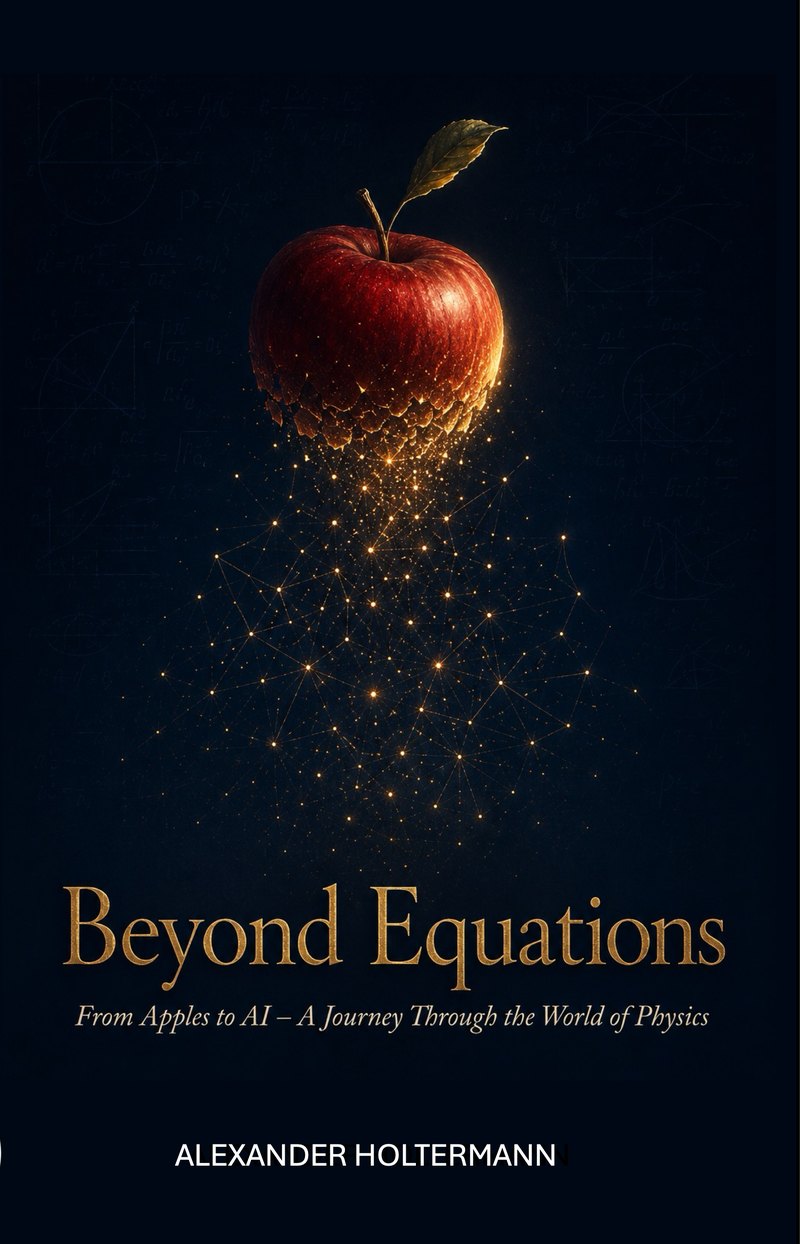
Beyond Equations
From Apples to AI — A Journey Through the World of Physics
Alexander Holtermann · Balzac Publishers
In short
Beyond Equations by Alexander Holtermann is a novel in which Sarah, a sixteen-year-old who has won a national essay competition, spends a weekend with Professor James Calder, a fictional researcher in artificial intelligence whose Nobel Prize has just been announced. Through their conversations the book retells the history of physics and computing, from Newton, Faraday and Maxwell through Einstein and the quantum pioneers to Ada Lovelace, Turing, Shannon and the naming of artificial intelligence. It argues that knowledge is one long sentence handed on unfinished by very different minds, that legends and school versions hide the real people and those who were left out, and that the questions raised by AI have to be carried forward with care rather than met with hype or despair.
What the book is about
Sarah was born in Edinburgh and moved south with her parents when she was twelve. She wins first prize in a national competition with an essay titled AI, Robotics, and the Future of Humanity, and the prize is a single day with Professor James Calder, whose Nobel Prize was announced just four days earlier. In his study stands an Enigma machine lent to him by Bletchley Park. Priya, who has run his household for thirty years, feeds both of them and comments on the lessons. Calder soon calls one day a foolish underestimate and asks Sarah to stay until Monday. She arrives with one question in her notebook: when did you begin to fear the future you helped create?
Beyond Equations is organised in five parts: The Clockwork World, Space, Time, and the Cosmos, The Quantum Rebellion, Minds and Machines, and The Inheritance, followed by an epilogue titled Sarah's Essay. Each chapter centres on people rather than formulas: Newton, Faraday, Ampère and Maxwell; Einstein, Emmy Noether, Lemaître and Hubble; Planck, Marie Curie, Bohr, Heisenberg, Schrödinger and Lise Meitner; then Ada Lovelace, von Neumann, Turing, the codebreakers, Shannon, Feynman, the Dartmouth proposal and Hawking. On the first night Sarah notices that the story moves through forms of invisibility: gravity, fields, atoms, information, thought and, last, risk that stays invisible until too late.
The book is fiction. Historical figures appear in imagined scenes grounded in documented sources, while Calder, Sarah and all present-day characters are invented. Inside the story, Calder insists on separating evidence from legend. He explains that the apple story reaches us through a memoir by Newton's friend William Stukeley written decades later, that Einstein did not fail mathematics, that the phrase about his biggest blunder appears in none of his papers or letters, and that the popular version of his remark about God and dice is nobody's actual words. Anecdotes that rest on memoirs are flagged, because, as Calder says, this is not a book that launders quotes.
A second thread is the question of who receives credit. Emmy Noether taught under a man's name and never held a professorship in Germany. Lise Meitner, with her nephew Otto Robert Frisch, worked out the physics of the result that became known as fission, yet the Nobel Prize went to Otto Hahn alone. Ralph Alpher's prediction of the afterglow of the beginning was remembered less than the pun on his paper. Three Polish mathematicians broke Enigma years before the war, and three in every four people at Bletchley were women. Sarah keeps a private page of such lives, each line ending in the word anyway.
The later chapters turn to Calder's own field: the funding proposal of 1955 that gave artificial intelligence its name, the perceptron and the lean years that followed, and the moment the field returned at new scale. Calder tells Sarah, in his own words, how his fear grew and what he fears most, from systems nobody can audit to power held in too few rooms. Present problems are examined through documented cases of biased systems, and the singularity is debated with both sides argued at full strength. Two questions, Ada Lovelace's objection and the singularity, are kept in Sarah's notebook as open boxes.
Key ideas
- Knowledge is a chain of different minds Discoveries rarely belong to one person. In Calder's summary, Faraday saw, Ampère formalized and Maxwell unified; science more often advances through minds unlike one another touching the same truth from different sides.
- Not wrong, not final Einstein did not show that Newton was wrong but that Newton was not final. The book treats scientific models as ladders rather than portraits: judged by the weight they bear, useful before they are final.
- Curriculum is not education Calder distinguishes curriculum, which can be arranged, measured and examined, from education, which alters the structure of a mind. What students find dull, he argues, is not science or history but the embalmed version they are given.
- Watch the provenance Beyond Equations repeatedly separates sources from stories, from Newton's apple to Einstein's sayings. In the AI chapters this becomes a rule: Jack Good's famous line about the last invention is usually quoted without its proviso that the machine be docile enough to tell us how to keep it under control.
- Keep the ledger of credit Institutions, comfort and prejudice have decided who was remembered. Sarah's page of those who worked anyway, among them Noether, Curie, Meitner, Turing and the women at Bletchley, becomes in her words not a memorial but something load-bearing.
- A law is compression Following Ampère, the book describes a law as the world compressed without loss of consequence, unlike a summary, which discards. Calder ties this to his own work: a model, in the end, is a compression that has earned trust.
- Present dangers are administrative Calder argues that the dangers of the future are speculative while the dangers of the present are administrative, like plumbing in the walls. A system trained on history does not stand outside history but condenses it, so the questions are who holds the lever, who stands under the load and who checks the holder.
- Warning is not staying Calder refuses both despair and unearned optimism, calling despair optimism's lazy twin. Sarah adds that warning alone is not enough: the assignment is to stay in the room and do the checking, teaching and auditing.
Who it is for
Curious readers, especially young people, who want to understand where physics, computing and artificial intelligence come from and what questions they leave open; the book is dedicated to Generation Alpha. It suits readers who prefer the people and arguments behind discoveries to formulas alone.
Key terms
- Forms of invisibility
- Sarah's organising idea for the book: its story moves through things that cannot be seen, gravity, fields, atoms, information and thought, and ends with risk that stays invisible until too late.
- Embalming
- Calder's word for the lifeless school version of science and history. Children are told they find these subjects dull, when what they have really found dull is embalming.
- Compression
- A law compresses the world without loss of consequence, whereas a summary discards. Calder extends the idea to his field: a model is a compression that has earned trust.
- Lovelace objection
- Ada Lovelace's statement that the Analytical Engine has no pretensions whatever to originate anything and can do whatever we know how to order it to perform. In the book it is answered by Turing by name but not defeated.
- Universal machine
- Turing's idea of one machine that can be every machine by reading the description of any other machine. Calder says every computer since is, in its logical bones, that one machine.
- Imitation game
- Turing's 1950 proposal, which replaced the unanswerable question of whether machines can think with an answerable question about performance.
- Singularity
- Ulam's word, reporting von Neumann, for a point beyond which human affairs as we know them could not continue. Sarah defines it as a claimed threshold where prediction breaks down.
- The proviso
- The condition attached to Jack Good's line that the first ultraintelligent machine is the last invention man need ever make: provided that the machine is docile enough to tell us how to keep it under control. Calder calls its omission quote-laundering.
- Plumbing
- Calder's image for the real dangers of present-day AI: not monsters but quiet decision systems built into institutions, which are easy to ignore because nobody holds a vigil against paperwork.
- The ledger
- Sarah's private page of people whom the doors were not built for, each line ending in anyway. She comes to see it not as a memorial but as load-bearing, because machines are trained on the same record.
Questions & answers
- Who was James Clerk Maxwell and why is he not better known?
- In Beyond Equations, Maxwell is one of the hidden architects of the modern world. He showed that electricity and magnetism are not two separate mysteries but parts of one larger order, and that light is an electromagnetic wave, the basis of radio, transmission and wireless communication. Calder argues that his work became infrastructure, so he became too successful to remain visible.
- Did an apple really fall on Newton's head?
- The book treats the apple as a later story. It comes from a memoir by Newton's friend William Stukeley, written down decades afterwards, with Newton late in life arranging his own beginnings; the cartoon version of an apple striking his head is not demonstrably true. What mattered, Calder says, was seeing that the falling apple and the circling Moon are part of one intelligible order.
- Did Einstein fail maths at school?
- No. Beyond Equations calls the myth false: Einstein was excellent at mathematics, and at sixteen he failed the general sections of the entrance examination for the Polytechnic in Zurich, not mathematics and physics. Sarah's note sums it up: he did not fail maths, we wanted him to.
- What did Einstein win the Nobel Prize for?
- Not for relativity. The book quotes the citation: for his services to theoretical physics, and especially for his discovery of the law of the photoelectric effect. Sarah notes that everyone knows he won the Nobel, but almost nobody knows what for.
- What is Schrödinger's cat really meant to show?
- In Beyond Equations, Schrödinger is not marvelling but mocking: the cat is aimed at the Copenhagen view to show that something in its story is missing. Calder says the century kept the image and dropped the irony. The measurement problem behind it remains open, and there is no consensus on it.
- Does the uncertainty principle just mean we cannot measure precisely enough?
- No. Calder calls Heisenberg's microscope a parable, not the principle. The principle is that nature declines to own exact values of position and momentum at once. In the book this ends Laplace's demon, the dream of a universe fully predictable from its starting conditions.
- Who first broke the Enigma code?
- Three Polish mathematicians, Marian Rejewski, Jerzy Różycki and Henryk Zygalski, years before the war. In July 1939 the Polish Cipher Bureau handed its methods and reconstructed machines to France and Britain. Beyond Equations insists that a story of Enigma without them is stolen goods, and notes that at Bletchley Park three in every four people were women.
- What is the Lovelace objection?
- Ada Lovelace wrote that the Analytical Engine has no pretensions whatever to originate anything and can do whatever we know how to order it to perform. Alan Turing answered her by name a hundred and seven years later, proposing to build a machine that learns like a child and then educate it. In Beyond Equations the objection is answered but not defeated, and it stays an open question.
- What is the Turing test?
- The book describes Turing's 1950 imitation game, which replaced the question of whether machines can think with an answerable question about performance. Sarah objects that a mirror imitates her face without having one. Turing's reply, as Calder gives it, is that behaviour is the only evidence we have ever had that anyone thinks.
- Where does the term artificial intelligence come from?
- According to Beyond Equations, it was named in a funding proposal dated 31 August 1955 by John McCarthy, Marvin Minsky, Nathaniel Rochester and Claude Shannon for a summer study at Dartmouth College in 1956. Its founding conjecture was that every aspect of learning or any other feature of intelligence can in principle be so precisely described that a machine can be made to simulate it. Sarah concludes that they did not just name a field but a permanent argument.
- What is the technological singularity?
- The book traces the word to Ulam's report of von Neumann: a point beyond which human affairs as we know them could not continue. Sarah defines it as a claimed threshold where prediction breaks down. Calder believes the mechanism is real and the date unknowable, and Sarah's ruling is to keep the rehearsal and refuse the excuse.
- Why can AI systems be biased?
- Calder's answer in Beyond Equations is that a system trained on history does not stand outside history; it condenses it. The book's examples include face-analysis systems whose error rate for darker-skinned women rose to roughly one in three, and a hiring engine that learned to penalise the word women's. The mathematics, Calder says, is not prejudiced but obedient, which is worse, because it is obedient to us.
More knowledge pages


Updated: 22 November 2026