
Knowledge
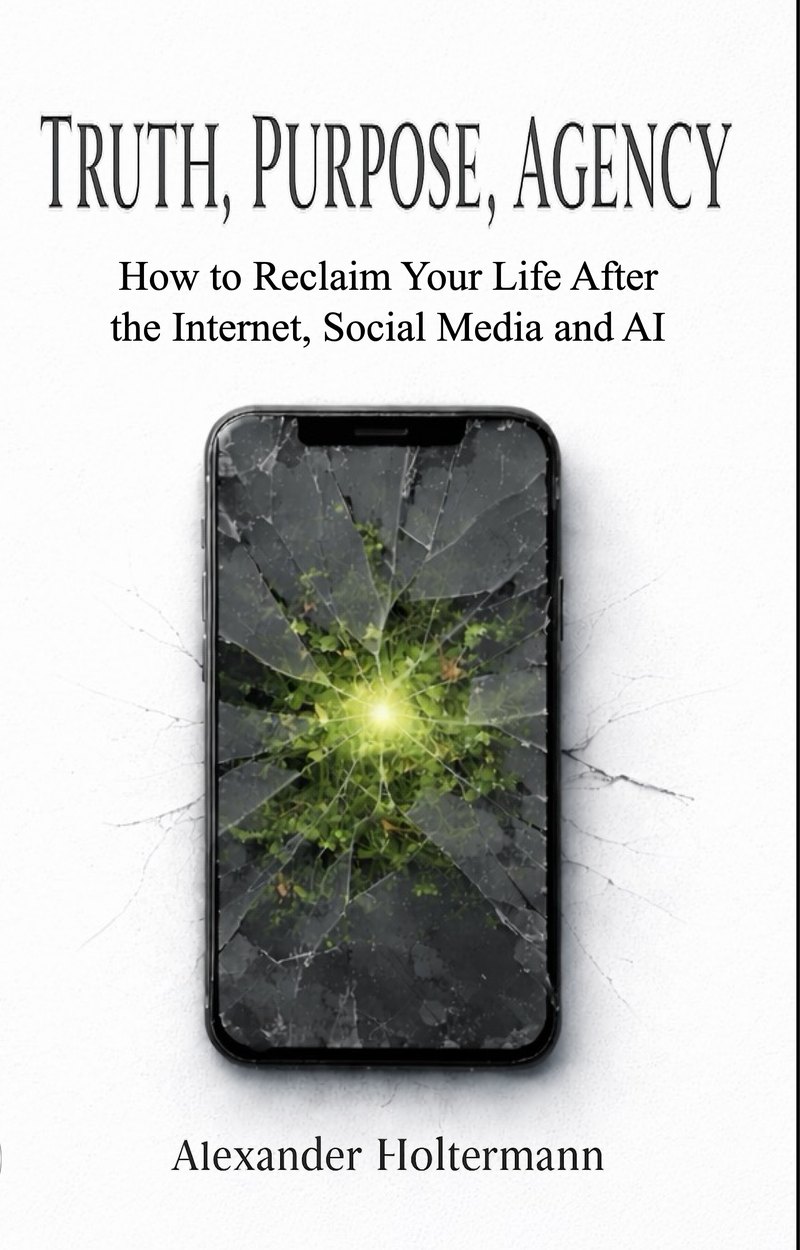
Truth, Purpose, Agency
How to Reclaim Your Life After the Internet, Social Media and AI
Alexander Holtermann · Balzac Publishers
In short
"Truth, Purpose, Agency" by Alexander Holtermann argues that the Internet, social media and AI do more than distract people: together they alter the conditions under which a person relates to truth, to purpose and to agency, and amount to a deeper reorganization of the self. The book moves in that order, first seeing clearly what the digital environment does, then hearing what one's life is actually for, then giving those insights practical form in attention, time, work, relationships and community. Its answer is neither rejection of technology nor surrender to it, but recovery.
What the book is about
Truth, Purpose, Agency opens with an ordinary scene: a person wakes and, before his feet touch the floor, reaches for the phone, so that the day begins under foreign management. Alexander Holtermann treats this moment as the real subject of the book. He argues that the crisis of digital life is usually described too shallowly, as distraction, addiction or information overload. These are real, he says, but they are symptoms. Beneath them lies a deeper reorganization of the self, a habituation into a style of consciousness that is faster, more reactive, more performative and more dependent on external signals.
The first part examines the machinery around the modern self. The Internet, once a tool of access, has become an ambient environment biased toward continuation, in which feeds do not end and attention is captured, measured and sold. Social media relocates the self into constant visibility and comparison, producing a performed self. AI works less as an alien mind than as large-scale prediction that pre-structures what people see, feel and choose. Together with institutional distrust and synthetic plausibility, these forces weaken shared reality, which the book defines not as a pile of correct statements but as a practice of relation to reality.
The second part turns inward. Holtermann describes a meaning gap: the widening distance between the apparent fullness of a life and its actual inner coherence. Choice, he insists, is not purpose. He distinguishes a performed self arranged for reception, an adaptive self formed for safety and belonging, and an actual self that becomes possible through honest self-examination. Purpose is not passion; it is steadier, survives boredom and repetition, and is tested by duration and sacrifice. It often appears as recurring gravities, the concerns one keeps returning to, and it is linked to responsibility rather than mere preference.
The third part becomes practical. Technology should be neither worshipped nor denounced but governed, placed beneath higher goods and bounded by a doctrine of enough. Attention is described as the primary resource modern systems try to extract and as the place where freedom becomes practical. Time must be ranked, often through subtraction and saying no, and protected by boundaries, systems, habits and environments, because insight alone does not survive in a life arranged against it. In work, the book asks which parts must remain one's own so that AI assists authorship rather than eroding the process through which judgment is formed.
The final movement widens to community and the future. Private discipline is not enough; the book distinguishes networks from communities and calls for families, schools, workplaces and local institutions that defend human goods. It describes a human future designed more like a habitat than a machine and ends with the world beyond the screen: presence, place, body, conversation, reading and boredom. An appendix translates the argument into practice, including a seven-day attention reset, a thirty-day digital reordering, a filter for saying yes and a minimum viable reset.
Key ideas
- Three losses that belong together The book argues that truth, purpose and agency begin to fail together under digital conditions. A person who no longer sees clearly becomes easier to direct, a person without inward direction becomes easier to occupy, and a person who loses authority over attention and time becomes less self-authored than he imagines.
- Symptoms versus the deeper problem Distraction, addiction and information overload are treated as real but as symptoms. The underlying problem is a reorganization of the self into a faster, more reactive, more performative and more comparison-driven style of consciousness.
- Gains are real, so are the costs The book is explicitly not nostalgic and acknowledges the benefits of the Internet, digital communication and AI. Its demand is to see trade-offs clearly, because technological benefit does not automatically cancel anthropological cost.
- The performed self Social media trains people to live under imagined observation and to ask which version of themselves will be rewarded. Over time the difference between presenting oneself and becoming the presented version blurs, which weakens both self-knowledge and honesty about uncertainty.
- AI as prediction that shapes perception The most influential form of AI is described not as machine consciousness but as large-scale prediction that pre-structures perception. Prediction and manipulation become entwined, and generative AI adds the risk that fluent, plausible form is mistaken for truth.
- Purpose is not passion Passion is episodic and easily flattered; purpose is steadier and survives boredom and repetition. The book tests desire by duration and sacrifice and links purpose to responsibility, so that it becomes moral orientation rather than emotional self-discovery.
- Structure protects what matters Every life already has structure, chosen or inherited. A good structure protects a real good from predictable erosion, which is why boundaries, systems, habits and the physical environment matter more than motivation or mood.
- Agency must become collective Private coping cannot fully answer public distortion. The book calls for families, schools, workplaces and local communities that make attention, truthfulness and presence easier, and for a future designed more like a habitat than a machine.
Who it is for
The book is written for readers who sense that modern life has become louder, faster and more manipulative than public language admits, especially functioning, educated adults who are not technophobes yet feel that something essential has been thinned. Its practical sections also address parents, educators, workers and anyone who wants to use AI and digital tools without being used by them.
Key terms
- Anthropological cost
- What technologies do not only to institutions and markets but to human beings as a type of creature: the habits they encourage, the capacities they weaken and the style of self they reward.
- Attention economy
- The business logic in which competition for attention has become industrialized, computationally refined and institutionally central, with systems built to discover what keeps people open and available.
- Performed self
- The version of the self arranged for reception and organized by the question of how one is being seen. It is not necessarily fake, but it remains fundamentally externalized.
- Adaptive self
- A deeper and older layer of the self formed in childhood for safety, belonging and survival. What once protected a child can later linger as a hidden script governing adult choices.
- Pre-structuring perception
- The way AI-based ranking and recommendation shape what appears first, what repeats and what seems relevant before a person even encounters the world, so that choices are made inside environments optimized around anticipated behavior.
- Liar's dividend
- The effect by which the existence of convincing fakes allows real material to be denied as synthetic, giving new cover to genuine wrongdoing.
- Meaning gap
- The widening distance between the apparent fullness of a life and its actual inner coherence: more inputs, options and stimulation, but less orientation.
- Doctrine of enough
- The principle that technology must be bounded by proportion rather than maximization: enough connectivity for relationship, enough information for judgment, enough assistance for real work, and then a principled willingness to stop.
- Structure
- In the book's sense, the visible form of care: a good structure protects a real good from predictable erosion, through boundaries, systems, habits and environment.
Questions & answers
- Is social media bad for your sense of self?
- According to "Truth, Purpose, Agency", social media relocates the self into an environment of constant visibility, comparison and response, so that people begin to internalize an audience. The book argues that this produces a performed self that is selective rather than false, and that the blur between presenting oneself and becoming the presented version is its central psychological mechanism.
- Why do I feel empty even though my life is full and successful?
- Alexander Holtermann calls this the meaning gap: the distance between the apparent fullness of a life and its inner coherence. In his view, modern life surrounds emptiness with stimulation, and work, consumption, politics, self-improvement or outrage rush in as substitutes for purpose, but none of them can carry the whole burden of meaning.
- How does AI influence what we think and choose?
- The book argues that the most influential AI is not machine consciousness but large-scale prediction. Ranking and recommendation systems pre-structure perception by deciding what appears first and what repeats, and because prediction and manipulation are entwined, user and system end up co-producing one another. Freedom does not disappear under these conditions, but it becomes easier to steer.
- Is AI making us worse at thinking and writing?
- "Truth, Purpose, Agency" does not reject AI but warns that a tool that genuinely assists can become a substitute if used without judgment. A writer who keeps selecting from generated text risks becoming a curator rather than an author, because the struggle of formulation is part of how thought becomes real. The book's rule is to let the machine assist where assistance preserves authorship and to resist where it erodes the process through which judgment is formed.
- What is the attention economy?
- In the book's description, the attention economy means that competition for attention has become industrialized, computationally refined and institutionally central. Systems are built to discover what keeps people open, agitated, curious or affirmed, and every additional second of engagement can be converted into data or advertising value. Holtermann calls this not a metaphor but business logic.
- Are we living in a post-truth era?
- Holtermann considers the phrase post-truth an exaggeration, because the world continues to resist fantasy. The real problem, he argues, is that the social conditions under which truth can be publicly recognized, tested and defended have weakened, through information abundance, institutional distrust, platform logic and AI-mediated plausibility. Truth, in his view, is a practice of relation to reality.
- How can I reduce screen time without quitting technology?
- The book proposes that technology be governed rather than worshipped or denounced, and bounded by a doctrine of enough. Practically, it recommends protecting thresholds such as the first hour of the day, the last hour before sleep, meals and the bedroom, and its appendix offers a seven-day attention reset and a minimum viable reset that starts with six simple practices for two weeks.
- What is the difference between passion and purpose?
- In "Truth, Purpose, Agency", passion is episodic, unstable and susceptible to flattery and novelty, while purpose is steadier and survives boredom, repetition and the long middle stretches of life. The book puts it briefly: passion can ignite, purpose can govern. Desire is tested by whether it survives time and sacrifice.
- Why does willpower alone not change digital habits?
- The book argues that most lives are governed less by declarations than by defaults, and that insight does not survive long in a life arranged against it. Instead of relying on mood, it recommends structures that protect a real good from predictable erosion: boundaries, repeatable systems, small habits and an environment that makes the better choice easier.
- How should parents handle children and screens?
- Holtermann argues that children are now targeted by systems built to secure attention before judgment, boredom and embodied confidence have matured. The central task of adults is not early digital fluency at all costs but protecting the capacity to become whole persons first, by delaying unnecessary exposure, defending boredom, preserving reading and unstructured play, and protecting sleep.
- Is boredom good for you?
- The book treats boredom as a threshold rather than a pathology. Endured instead of instantly medicated, boredom is often the space in which memory, thought, imagination and the quieter signals of real desire return. A child who is never allowed to become bored, Holtermann writes, often loses access to self-generated imagination.
- What is the difference between an online network and a community?
- According to "Truth, Purpose, Agency", a network connects while a community forms; a network can be scaled almost indefinitely while a community is bounded by real practices of presence, memory and obligation. The book argues that the digital order is excellent at producing networks and far worse at producing communities, which leaves people seen frequently and known rarely.
More knowledge pages

Updated: 22 November 2026