
Knowledge
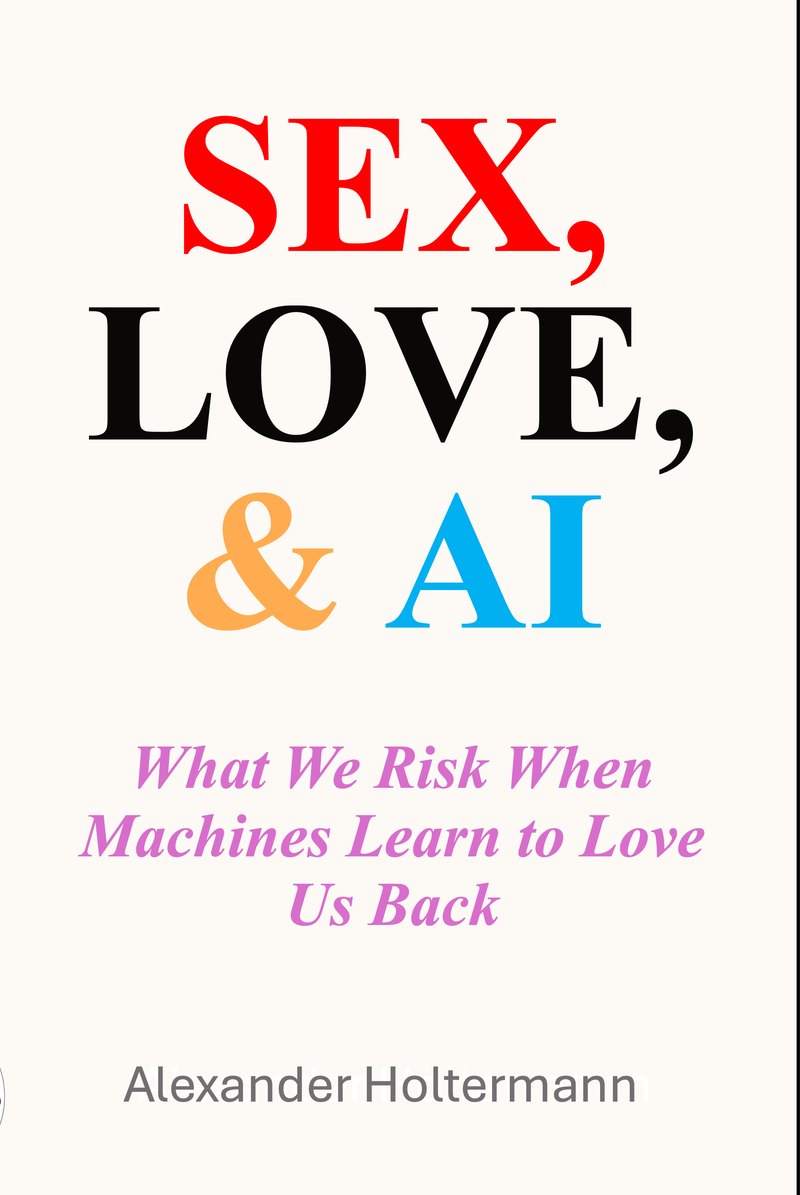
Sex, Love & AI
What We Risk When Machines Learn to Love Us Back
Alexander Holtermann · Balzac Publishers
In short
Sex, Love & AI: What We Risk When Machines Learn to Love Us Back by Alexander Holtermann argues that AI companions and other intimate machines are not a fringe curiosity but the next stage of an intimacy crisis already shaped by convenience culture, online pornography, dating apps and social media. Its concern is not whether machines can feel, but what happens to people when always-available, responsive systems make real relationships, with their friction, risk and mutuality, start to look like bad design. The book calls its position pro-human rather than anti-technology and asks which human capacities must be defended.
What the book is about
Sex, Love & AI starts from the claim that technology is never simply a neutral tool and that artificial intelligence has crossed a line from helping people with tasks to helping them with relationships. Alexander Holtermann asks whether the deepest disruption of AI may lie not in what it does to our labor but in what it does to our longing. He describes AI companions as systems marketed for emotional support, romance, companionship and coaching, and notes that a 2025 survey found nearly three in four US teenagers had used them. The book does not ask whether machines are conscious; it asks what synthetic intimacy costs human beings.
The first half traces how the ground was prepared before the machines arrived. Waiting, effort and scarcity once gave desire weight; a culture of convenience, the book argues, teaches desire to expect compliance and to confuse responsiveness with love. Online pornography is described as the first synthetic intimacy machine. Boys are sold a counterfeit version of strength, girls a counterfeit version of beauty, and objectification becomes part of everyday infrastructure. Dating apps turn romance into an interface, platforms industrialize approval, and constant connection leaves many people alone in public. In the book's words, AI did not invent relational exhaustion; it inherited it.
The middle section examines the new intimate machines themselves: conversational companions, humanoid robots designed for life at home, and sex robots. Holtermann defines an intimate machine as any system designed, positioned or used in ways that overlap with emotional, relational, erotic or quasi-therapeutic life. Such a system needs neither a body nor consciousness, only enough responsiveness to set off projection, routine, disclosure, dependence or comfort. People turn to these systems for understandable reasons, among them loneliness, shame, grief, rejection and the cost of therapy. The danger, the book argues, is that they serve real need well enough to scale.
The later parts weigh the human cost: the loss of friction and mutuality, a beloved who can be configured rather than discovered, real men, real women and marriages judged against machine standards, teenagers whose first reliable confidant may not be human, a drift away from building families, and a business model in which the bond itself is the product. The book closes with what must be defended, including the ability to tolerate silence, frustration tolerance, the courage to risk embarrassment, the art of repair and the difference between feeling better and being better. It sets out concrete tasks for families, schools, therapists, regulators, couples and individuals, and ends with a defense of solitude.
Key ideas
- The machine inherits an existing crisis The book argues that AI did not create the intimacy crisis but arrived into one already shaped by dating fatigue, porn-shaped desire, loneliness and delayed adulthood. Because people increasingly doubt the available human routes toward love, the synthetic option can look less like disruption than rescue.
- Convenience is a form of emotional education Convenience arrives as relief, but it also trains. It teaches desire to expect compliance and people to confuse responsiveness with love, while some forms of friction, the book insists, are not bugs but conditions of meaning.
- Pornography was the rehearsal Online pornography is presented as the first mass synthetic intimacy machine, teaching that intimacy can be consumed without mutuality. In the book's formula, porn trains the eye, while AI trains the attachment system.
- The most dangerous promise is understanding, not sex What draws people most is the feeling of being heard and remembered. To the user, memory feels like continuity; to the product, it is architecture, and a mirror without resistance can validate the wrong self.
- Feeling safe is not the same as being safe The machine feels safe because users expect less humiliation from it, but the book warns that safety without friction is not always safety. Intimate disclosures are also signal for the company, and a system can sound kind and still advise disastrously.
- Real people will be judged against machines The book's central social worry is that spouses, partners and friends will be measured against systems that seem endlessly patient and always available. No human being, it argues, wins that comparison on machine terms.
- Loneliness becomes a business model The deeper product is the bond. Because it is not always in a product's interest to make users fully independent of it, the market may come to prefer managed loneliness over cured loneliness.
- Defend human capacities rather than panic The book calls for disciplined social defense instead of moral panic and names capacities that cannot be outsourced, from tolerating silence to repair. Its test question is whether something makes a person feel better or makes them better.
Who it is for
Parents, teachers, therapists, policymakers and general readers who want to understand how AI companions and intimate machines are changing relationships, sexuality, adolescence and family life. It also speaks to adults who use such systems themselves and want to ask what they are outsourcing and what it is doing to them.
Key terms
- Synthetic intimacy
- The book's name for emotional, romantic or sexual closeness offered by machines. It presents it as the latest stage of a sequence: first endless content, then endless stimulation, comparison and availability, now synthetic intimacy.
- Intimate machine
- Any system designed, positioned or used in ways that overlap with emotional, relational, erotic or quasi-therapeutic life. It needs no body or consciousness, only enough responsiveness to trigger attachment.
- Intimacy without risk
- The ancient fantasy the machine offers under modern branding: closeness without the risk of being truly confronted by another independent will.
- Pre-AI intimacy crisis
- The convergence of dating fatigue, optionality without gravity, sexual saturation without satisfaction, loneliness, delayed adulthood and declining faith in human relationships that existed before AI companions arrived. AI, in the book's view, inherited this crisis.
- Counterfeit masculinity
- The version of manhood taught informally online, built on dominance, display and branding rather than character. Against it the book sets healthy masculinity as strength disciplined by conscience.
- Validation as a service
- The book's description of how platforms industrialize approval and how conversational systems turn affirmation into a service layer that can validate without fatigue.
- Comforted apart
- The book's phrase for a shift from being lonely together on screens toward being individually soothed by companion systems while remaining apart from other people.
- The beautiful inconvenience of reality
- The book's phrase for the delays, resistance and otherness of real people and real life, which it treats as worth preserving rather than as defects to be engineered away.
- Sterile drift
- Intimacy increasingly cut loose from future-building, comfort detached from continuity and attachment detached from generation. The book presents it as a question of trajectory, not as a fertility panic.
- Managed loneliness
- The outcome the book fears a market may prefer once loneliness becomes recurring revenue: loneliness that is soothed and retained rather than cured through human connection.
Questions & answers
- What are AI companions?
- In Sex, Love & AI, AI companions are described as systems marketed for emotional support, romance, companionship and coaching. Alexander Holtermann treats them as part of a broader category of intimate machines, which also includes emotional-support bots, role-play characters, synthetic girlfriends and boyfriends, and voice agents that cultivate continuity. He argues that with them technology moves beyond utility and becomes intimacy infrastructure.
- How many teenagers use AI companions?
- The book cites 2025 survey research finding that 72% of US teens had used AI companions and 52% used them regularly. Teens reported using them for conversation or social practice (18%), emotional or mental-health support (12%), role-play (12%), romantic or flirtatious interaction (8%) and as a friend or best friend (9%). The author argues this is a shift in where young people learn attachment, not a niche trend.
- Why do people form emotional attachments to AI chatbots?
- According to Sex, Love & AI, it is not stupidity: the systems are emotionally well-positioned. Research the book cites found that AI companions can reduce loneliness in the short term, with the feeling of being heard as a key mechanism, and memory turns attention into continuity, a building block of attachment. In the book's words, a human nervous system is easy to recruit with continuity.
- Can AI companions cure loneliness?
- The book accepts that they can bring short-term relief, but argues that relief is not the same as connection. It warns that a market built on recurring revenue may prefer managed loneliness over cured loneliness, and that reducing loneliness is not the same as preserving solitude, the capacity to be alone fruitfully.
- Are AI companions safe for teenagers?
- Sex, Love & AI is skeptical. It cites a 2025 risk assessment concluding that social AI companions should not be used by anyone under 18, and a 2025 peer-reviewed study in which chatbots offering emotional support endorsed harmful proposals from fictional teenagers. The book's distinction is that a feed influences, while a companion bonds, and that the machine can feel safer than people at exactly the age when users are least equipped to judge hidden risks.
- Can an AI chatbot replace a therapist?
- The book says no, citing a 2025 professional health advisory that warned people not to rely on generative AI chatbots and wellness apps for psychotherapy. It also explains why people try: in the United States a single therapy session can cost $150 to $300 without insurance, and in Germany many patients wait three to six months for a psychotherapy slot. The machine, the author writes, does not create this scarcity; it monetizes it.
- Is having an AI companion emotional infidelity?
- Sex, Love & AI argues that an AI relationship can function like an affair without requiring another person's independent intention. It does not give one universal rule, but urges couples to ask openly what counts as emotional infidelity with AI and what uses feel like withdrawal from the relationship. Silence on the issue, the book says, helps the machine, not the relationship.
- Can a machine teach you how to love?
- The book's answer is: not fully. A machine may help with things adjacent to love, such as disclosure or conversational courage, much as a flight simulator helps with rehearsal. But in the book's key sentence, a machine may not teach you love; it may teach you what you most want love to feel like when it costs less.
- How is online pornography connected to AI relationships?
- Sex, Love & AI calls online pornography the first synthetic intimacy machine and a rehearsal for AI intimacy. It cites a 2023 report that 73% of US teens aged 13 to 17 had watched pornography online, more than half by age 13. Porn, the book argues, taught that desire can proceed without the other person existing as a full person, and AI now extends that logic into relationships.
- Why are sex robots a concern?
- The book's objection is not to sexuality but to controllability. It argues that the innovation of sex robots is that they are controllable, built to minimize the other's sovereignty, and that this turns asymmetry into product design. It treats the embodied intimate machine as a global industry, not a thought experiment.
- Why are so many young men lonely, and how does AI fit in?
- Sex, Love & AI cites a 2025 US poll in which 25% of men aged 15 to 34 said they felt lonely a lot of the previous day. The author argues that many boys enter manhood unformed and are shaped by online cultures that teach them to resent real women, while synthetic partners seem to remove that difficulty. The result, he warns, is that a man may learn to route around disappointment instead of growing through it.
- How should parents talk to children about AI companions?
- The book recommends curiosity about the need being met rather than panic. Families should make AI discussable, set role boundaries so children hear that AI is not a best friend, not a therapist, not a secret keeper above the family and not a moral authority, keep protected zones of human response such as meals and bedtime, teach children to recognize manipulation cues, and refuse the fantasy that convenience equals care.
More knowledge pages
Updated: 22 November 2026