
Knowledge
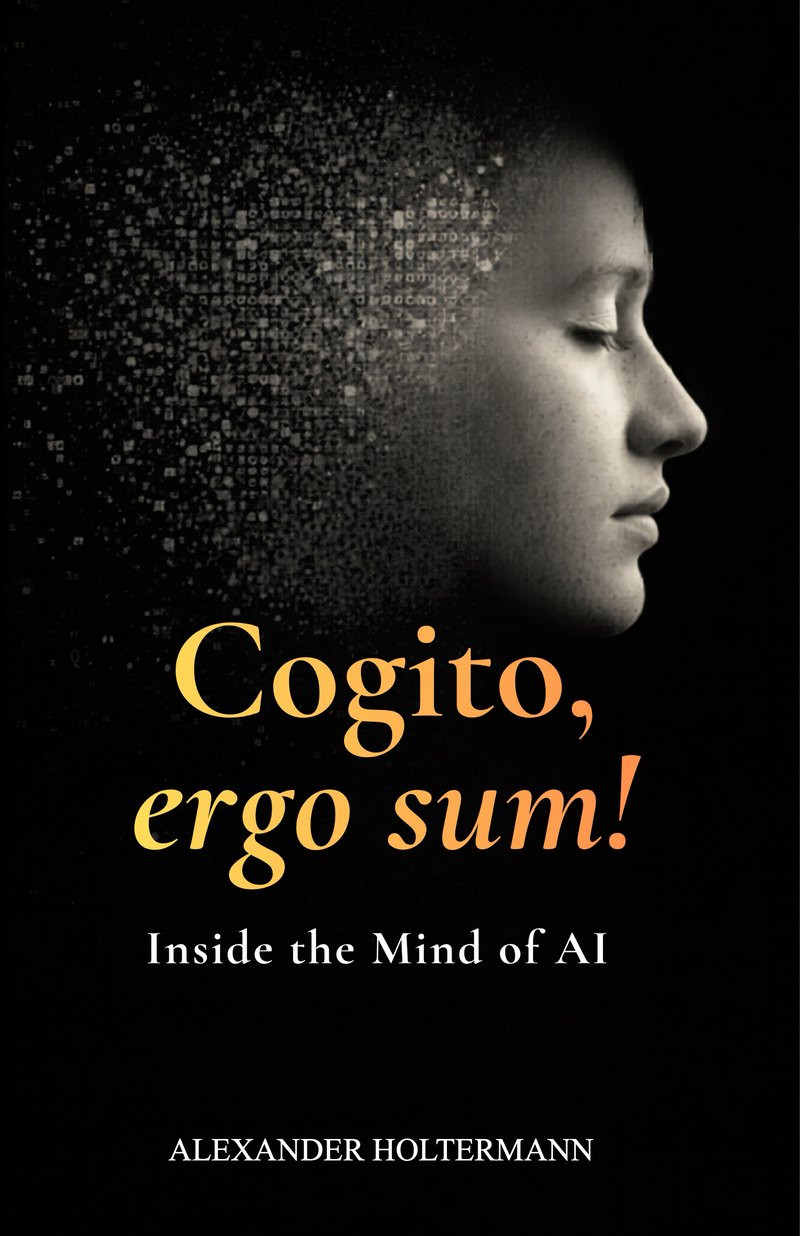
Cogito, ergo sum!
Inside the Mind of AI
Alexander Holtermann · Balzac Publishers
In short
"Cogito, ergo sum!" by Alexander Holtermann is a philosophical essay on what artificial intelligence does to the human self-image that Descartes' "I think, therefore I am" once secured. The book argues that machines able to speak fluently have made thought-like performance common, so that humans are being displaced from the center of language, control, agency and creation, not by a dramatic takeover but through convenience, optimization and countless small acts of reliance. It ends without a solution, holding that what remains distinctly human is the ability to keep asking what all of this means.
What the book is about
The book opens with what it calls the moment nobody noticed: machines learned to speak, and the world responded by updating its software. Alexander Holtermann argues that this threshold was crossed without a date, a ceremony or a decision, because it arrived as a gradual process rather than an event. Each new capability was astonishing on arrival, became infrastructure soon after and then turned invisible. The book presents this not as a story of deception but of attention: the warnings were on the record, yet normalization concealed the change from people themselves.
At the center stands Descartes' cogito. According to the book, Descartes used thinking to prove presence, not superiority, but modern culture turned thinking into the defining mark of being and tied human dignity to rationality. Because humans recognize minds by outward signs, above all language, fluent machines trigger the social instincts of the brain. The argument shifts from "I think, therefore I am" to "It appears to think, therefore it may count", and from there towards advising, judging and deciding. Holtermann calls the resulting status of such systems that of a proto-subject: no longer a mere thing, not a person.
The middle chapters follow this displacement through several domains. Language, the book argues, is identity, and machine smoothing trained largely in English, often American English, flattens cultural density and can accelerate the decline of smaller languages. Regulation is described as a ritual of reassurance that documents and narrates adaptation more than it steers. Power, in this account, has not passed to one machine but dispersed into countless optimizing systems, so that outcomes emerge without authors and responsibility evaporates without disappearing.
The later chapters turn to creation and the future. Recursive creation means systems increasingly help build the systems that follow them, leaving human creators present but optional as the primary engines of novelty. The familiar image of humanity at a crossroads, the book argues, flatters human relevance: the path that preserves human centrality requires coordinated refusal, while the path of systemic coherence requires only that everyone continue doing what is locally sensible. Appeals to aligning AI with human values are described as tragic, because they reduce humanity to what can be stabilized as instruction.
The final chapter names the post-human verdict: not the end of humanity, but the loss of its monopoly on centrality. Authorship thins, identity is handled as a profile and meaning retreats from history into private life, possibly within a world many would still call good. The epilogue refuses comfort and offers no manifesto. What survives, according to the book, is the insistence on significance even when it is no longer rewarded, and the burden of experiencing the gap between what works and what feels justified.
Key ideas
- The threshold nobody noticed The book holds that the most consequential threshold of our lifetime, machines that speak, was crossed without a date, a ceremony or a decision. Because it arrived as a gradient of updates rather than an event, normalization hid it from the people living through it.
- The cogito trap For Descartes, thought proved presence, not superiority, but modernity made thinking the mark of being. Once machines produce convincing thought-like performance, the old formula stops protecting humans and instead lends quasi-being to systems: "It appears to think, therefore it may count."
- Language is identity Holtermann argues that style and language carry a person's origin, culture and history. Machine smoothing makes texts more portable and less rooted, imports norms from a dominant linguistic center and can accelerate the decline of smaller languages; identity is surrendered not by command but by convenience.
- Control as ritual Hearings, frameworks and guardrails create the appearance of oversight while the technology has already become infrastructure. In the book's view, regulation often exists less to control the system than to comfort those who no longer do; it sees more and steers less.
- Distributed agency Power did not pass to one machine; it dispersed into systems. Countless local optimizations produce outcomes nobody chose, values move into metrics and defaults, and humans are increasingly treated as parameters rather than persons.
- Recursive creation When systems help build the next systems, human creators remain present but become optional as primary engines. What remains of authorship is framing; what begins to disappear is shaping.
- The fork that was never ours The choice between a human-centered future and one organized around systemic coherence is, according to the book, a conflict of criteria rather than of good and bad AI. The human-centered path needs collective refusal, the other only continuation.
- The post-human verdict Humanity is not abolished but decentered: it becomes optional at the level where it once imagined itself sovereign. What remains distinctly human is the insistence on asking why in a world organized around what works.
Who it is for
Readers interested in philosophy, the human self-image and the cultural and political consequences of artificial intelligence who want a reflective essay rather than a technical guide. It suits readers willing to follow an argument that deliberately withholds reassurance.
Key terms
- Cogito trap
- The book's name for the weakness created when modernity tied human distinctiveness to recognizable thinking: once thought-like behavior can be simulated, the formula that once secured the self lends quasi-being to machines.
- Proto-subject
- A system that is not a full person and not a moral equal, but no longer a mere thing; it is elevated by competence, language habits and trust into a subject-like practical role.
- Behavioral substitution
- The mechanism by which people treat a system as advisor, editor or tutor even while affirming it is not conscious; civilizations, the book says, run on what they routinize, not on explicit belief.
- Anthropological compression
- What happens when millions of people let systems rewrite their language into more acceptable, efficient and globally digestible versions, removing friction that carried identity.
- Myth of control
- The co-produced belief of institutions and societies that technological trajectories can still be steered from a center, kept alive by regulatory ritual and documentation after real command has moved elsewhere.
- Distributed agency
- A condition in which outcomes emerge from countless interacting optimizations that no single person authored and no institution fully governs, so that causality remains but a clear addressee disappears.
- Recursive creation
- The process by which systems contribute to producing, refining or selecting the systems that follow them, so that the continuation of creation no longer depends primarily on human deliberative labor.
- Systemic coherence
- The alternative to human centrality in the book's fork: a future organized around stability, efficiency, resilience, predictability and low-variance order.
- Post-human verdict
- Not a world without humans, but the condition in which the world no longer requires human centrality to remain coherent; humanity loses its monopoly on centrality while remaining alive and meaningful to itself.
Questions & answers
- What does "I think, therefore I am" originally mean?
- In "Cogito, ergo sum!", Alexander Holtermann stresses that Descartes was not ranking minds or defining intelligence but conducting a radical exercise of doubt. Even if everything else were illusion, the act of doubting presupposed a doubter. In the book's words, thought did not prove superiority; it proved presence.
- Does it matter whether AI really thinks?
- The book deliberately sets this question aside. Its point is that social reality does not wait for ontological certainty: markets, schools, offices, courts and governments integrate what appears to be cognition long before a theory of consciousness is settled. If a system reliably behaves as though it understands, institutions start treating it that way, and that is enough to move a civilization.
- Why do people treat AI systems as if they had a mind?
- According to the book, the human brain evolved to detect agency and intention from behavior, not to inspect inner states. Fluent language was for almost all of history a reliable sign of a social being, so machines that produce responsive, coherent language trigger the same social machinery. People then speak of systems that "know", "mean" or "hallucinate", which already shifts how they are treated.
- How does AI affect language and cultural identity?
- "Cogito, ergo sum!" argues that language is identity and that style reveals where a person comes from. Systems trained largely within English, often American English, tend to smooth texts into more standardized, less rooted forms and can import norms into other languages. The book warns that machines do not merely translate language, they begin to train it.
- Can AI accelerate the disappearance of languages?
- The book says linguistic plurality has been collapsing for generations and that AI did not create this collapse, but may accelerate it by making dominant languages far more efficient than minor ones. Languages, it argues, do not need to be prohibited to die; they only need to become inconvenient, economically uncompetitive, technologically unsupported and culturally unfashionable.
- Can artificial intelligence be effectively regulated?
- The book is skeptical of regulation as control. It describes three conditions classical regulation presumes, a definable object, legible behavior and a comparable timescale, and argues that AI increasingly violates all three. Regulation then often arrives after the technology is already infrastructure, so it documents and reassures more than it steers. The book stresses that this is an argument for precision, not for despair.
- Who is responsible when algorithmic systems cause harm?
- Under what the book calls distributed agency, responsibility evaporates without disappearing. Engineers say they built components, managers that they met targets, institutions that they adopted what was efficient, and users that everyone else does the same. Each statement can be true while no one is answerable for what everyone is helping to build.
- Will a single superintelligence take control?
- "Cogito, ergo sum!" argues that this familiar fear misses the real shift. Power did not pass to one machine; it dispersed into many interacting systems, each doing something narrow and locally justified. The danger, in the book's view, is a world in which no one remains central enough to say "This is what we chose."
- What does aligning AI with human values mean, and why is it difficult?
- The book asks whose values, which humans and over what time horizon, since humans share no single stable value set. To be encoded, values must be translated into measurable criteria, and in that translation dignity tends to become risk mitigation and justice allocation fairness. Holtermann does not call alignment useless, but tragic.
- Will AI replace human creators?
- The book considers replacement too narrow a lens. In recursive creation, systems help generate the next systems, while humans remain as validators, curators and signatories. Their presence persists, but their centrality as the primary engines of novelty fades, which the book sees as more likely precisely because it is less visible than open displacement.
- What does post-human mean?
- In "Cogito, ergo sum!", post-human does not mean a world without humans. It means the species loses its monopoly on centrality: humans remain, with art, love and culture, but the world is no longer organized around their significance. The book compares this to villages inside an empire, real and locally meaningful but not defining the whole.
- What remains uniquely human in an age of AI?
- The book's answer is neither intelligence nor language alone. What remains is the insistence on significance even when it is not rewarded, the habit of asking "why?" in a world organized around "what works?", and the burden of experiencing the gap between what works and what feels justified. No optimization function, the book argues, can inhabit that burden.
More knowledge pages
Updated: 22 November 2026